Robotic Ice Cream Kiosk: The 2026 Starter Guide for U.S. Venue Owners
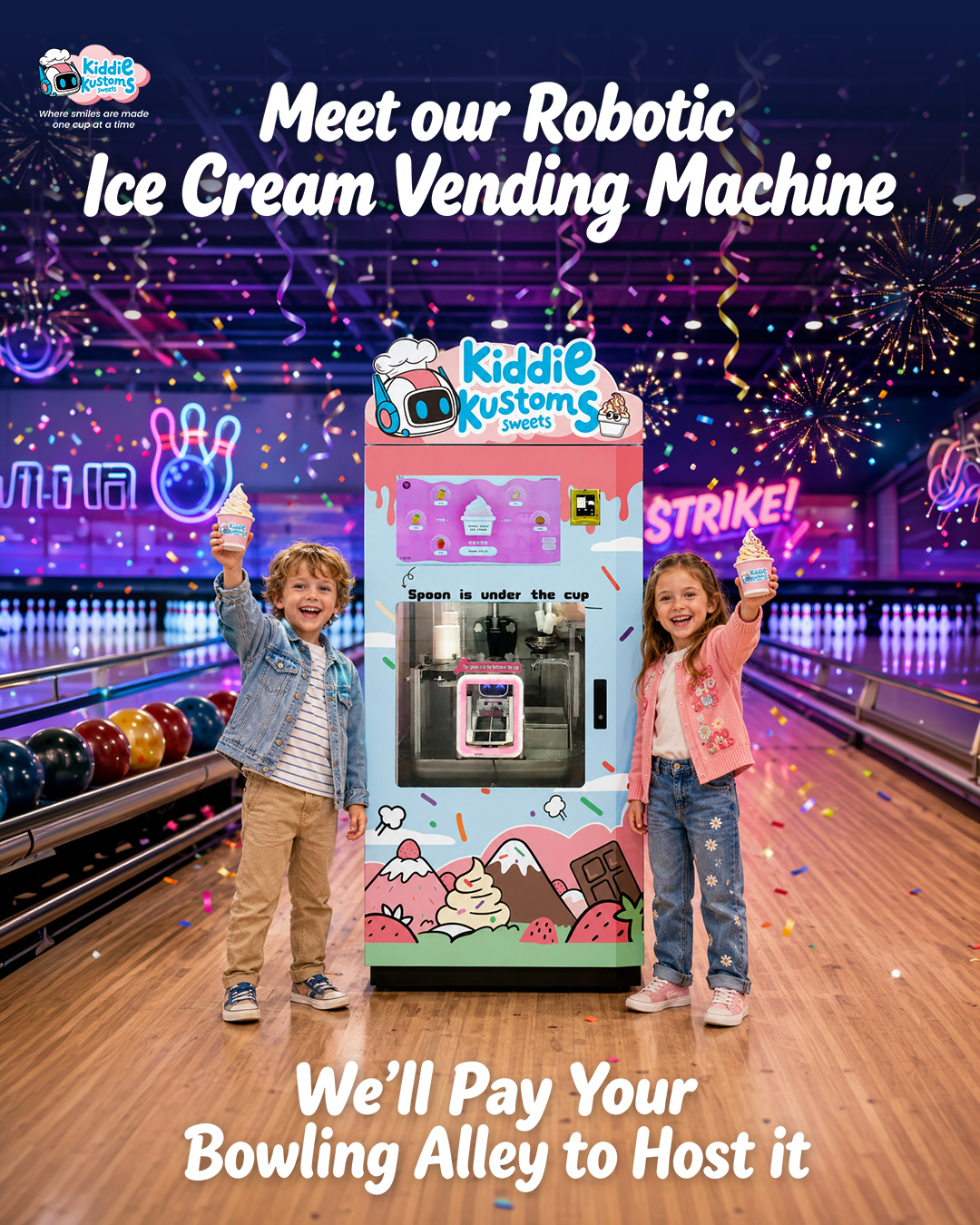
A robotic ice cream kiosk is a self-contained, unattended machine that makes fresh soft-serve ice cream to order with a robotic arm — no counter staff, no freezer stock, no pre-made cups waiting to melt.
If you run a venue — a restaurant, bowling alley, playground, or any business with families walking through the door — this is the guide you need before you talk to any supplier. It walks the full journey: whether a kiosk fits your business, what the machine needs, the three ways to get one, what it costs and earns, and the questions first-time buyers always ask.
Is a robotic ice cream kiosk right for your business?
Answer these three questions honestly before going further:
Do you have foot traffic? A kiosk earns from impulse purchases. The best sites are indoor, high-traffic, family-oriented spaces where people already linger.
Do you have about 11 square feet? Robotic kiosks are compact but not tiny. The K1 from Kiddie Kustoms Sweets, for example, fits in about 11 sq ft (31.5"W × 50"L × 70.9"H).
Do you have a dedicated electrical circuit? Robotic machines need real power. The K1 requires a dedicated 240V/20A circuit; other units run on 110V/120V. If you cannot provide one, placement is still possible through a supplier that handles electrical planning with you.
If you answered yes to all three, a robotic kiosk is worth a serious look.
What a robotic ice cream kiosk is (and is not)
It is not a traditional soft-serve machine, which needs a trained employee to operate and clean.
It is not a freezer vending machine, which sells pre-packaged bars and sandwiches.
It is an automated mini dessert shop: a customer orders on a touchscreen, a robotic arm picks a cup, dispenses fresh soft serve, adds toppings and syrups, and delivers the finished cup — typically in 30–45 seconds.
The result is a fresh, made-to-order product with no labor behind the counter — the reason the format is spreading across U.S. venues.
The 5 things every robotic ice cream kiosk needs
1. Space. About 10–12 sq ft of high-visibility indoor space, ideally near where families already gather.
2. Power. A dedicated circuit — 240V/20A for the K1, 110V/120V for other models. No plumbing or water hookup is needed.
3. A service plan. Someone must install, clean, restock, and repair the machine. The K1 includes supplier-side installation, cleaning, maintenance, restocking, and support.
4. Cashless payments. U.S. consumers pay by card and mobile wallet. The K1 uses integrated cashless card payments with remote monitoring.
5. A clear business model. Buy the machine and keep all revenue, or host it under a revenue-share arrangement with zero capital outlay.
The three ways to get one
Buy a U.S.-distributed machine outright. You own the equipment and keep 100% of revenue. Expect a five-figure investment plus delivery, install, and training.
Source factory-direct. Chinese factories quote robotic kiosks from about $4,000 to $8,600, per Accio supplier data (retrieved September 2026). You take on freight, duties, certification, and your own service plan.
Host a machine with zero capital outlay. The supplier provides, operates, and maintains the kiosk; the location shares revenue. Kiddie Kustoms Sweets offers revenue share up to 50% to the venue.
What it costs — and what it can earn
Cost: factory-direct units run $4,000–$8,600 (per Accio); U.S.-distributed machines typically cost several times more; hosting costs $0 upfront.
Earnings benchmark: typical vending machines generate $300 to $1,500 per month with 25–35% net margins, per VendBuddy's 2026 industry statistics. Robotic kiosks sell a higher-priced fresh product and target the top of that range.
Company-reported potential: Kiddie Kustoms Sweets' promotional materials cite up to $5,000 per month per location and 80–85% margins at high-traffic sites.
Context: Americans eat about 18 pounds of ice cream per person per year, with production peaking March–September, per IDFA — a strong seasonal curve, not a year-round guarantee.
FAQ — what first-time buyers ask
Does it need staff? No. The kiosk operates unattended; the supplier handles cleaning and restocking on a schedule.
Does it need plumbing? No. It is self-contained — only power is required.
What if it breaks? Remote telemetry flags issues early. Ask who repairs it and how fast before you sign.
How fast is payback? That depends on the model and traffic. See the worked payback examples in the cost guide; treat all estimates as benchmarks, not promises.
What about winter? Expect a strong March–September curve. Plan promotions or seasonal placement around the off-season.
Case study: the K1 by Kiddie Kustoms Sweets
Kiddie Kustoms Sweets LLC (Devon, PA) designs and distributes the factory-patented, CE-certified K1 robotic ice cream kiosk with a U.S.-based service footprint: installation, cleaning, maintenance, restocking, and support within roughly an hour of the Philadelphia Main Line.
K1 highlights: about 30 seconds per cup; one base flavor with up to five toppings and syrups; a 22-inch touchscreen; cashless card payments; a 2.1-gallon tank (about 60 cups per fill); 4.6 oz servings; about 11 sq ft footprint; 529 lbs; a 240V/20A dedicated circuit; batch orders up to 6 cups.
Live deployments include Dim Sum King (King of Prussia, PA), The Barn Yard (Collegeville, PA), Devon Lanes (Devon, PA), Flick of the Wrist (Malvern and Broomall, PA), Junior Playland (Hyattsville, MD), Tilted Axes (West Chester, PA), and X-Golf Garnet Valley (West Chester, PA).
Contact: 609-779-2385