Commercial Robotic Ice Cream Vending Machine Factory: How to Source Directly
Why buyers look at factories: prices on B2B platforms run a fraction of U.S. list prices. Robot ice cream vending machines are quoted at roughly $4,000 to $8,600 by Chinese factories, per Accio supplier data (retrieved September 2026), versus significantly higher prices for U.S.-distributed units.
But a factory quote is a sticker price, not a delivered cost. This playbook walks through the six steps that separate a smooth factory purchase from a stalled container.
Step 1 — Write your commercial specification before you contact anyone
Throughput: how many cups per hour at peak. Robotic soft-serve machines typically make one cup every 30–45 seconds; that sets your queue length on busy days.
Capacity: servings per fill before restocking. A 2.1-gallon tank holds roughly 60 cups; larger units claim 100+ servings per fill.
Power: 110V/120V vs. 240V — know what your venue actually has. Most U.S. restaurants can handle a 240V/20A circuit; retail and convenience sites often need 110V.
Payments: a cashless card reader that works in the U.S.
Telemetry: remote monitoring for sales, temperature, and faults.
Footprint: robotic kiosks typically occupy about 10–12 sq ft of floor space.
Food-grade materials: stainless steel surfaces and FDA-compliant components.
Step 2 — Shortlist factories and run due diligence
Where the factories are: the majority of robotic ice cream vending kiosks are manufactured in China. B2B sourcing platforms list verified suppliers with ratings, years in business, MOQs, and audit reports.
Business license and years operating.
Third-party audit reports from independent inspection agencies.
Factory size, production lines, and QA staffing.
OEM/ODM capability if you want custom branding.
Patent portfolio — a factory with its own robot patents is a different risk profile from an assembler.
Ask for a live video walkthrough of the production line and the machine running — not just a brochure.
Step 3 — Price the full import and logistics chain
FOB vs. CIF vs. DDP: understand who owns shipping, insurance, and customs clearance.
Duties and tariffs: equipment imports are subject to U.S. tariffs; steel and aluminum tariffs have raised input costs across the industry.
Lead time: typical factory production runs 30–60+ days, plus transit and customs clearance.
Spare parts: order critical spares with the machine — a replacement pump or compressor from overseas can take weeks.
Step 4 — Build your U.S.-side service plan
Who installs the machine? Who trains your staff? Who handles cleaning and restocking?
Who repairs it? A robotic kiosk has moving parts — a robotic arm, dispenser pumps, and a refrigeration system — and downtime is lost revenue. Remote telemetry helps you diagnose, but you still need local hands. U.S.-based suppliers usually have a technician network; factory-direct buyers often end up paying for third-party service or waiting on shipped parts.
Step 5— Compare factory-direct vs. U.S.-based supplier on total cost, not sticker
Machine price: factory ~$4,000–$8,600 vs. U.S.-distributed units, which typically cost several times more.
Freight, duties, customs: you pay on factory-direct.
Certification: often missing on factory-direct units.
Service and parts: included or available locally with U.S. suppliers.
Time to revenue: weeks for a local supplier vs. months for the overseas route.
The right answer depends on your volume, your technical appetite, and your tolerance for downtime.
Case study: Kiddie Kustoms Sweets — a U.S.-based alternative to going direct
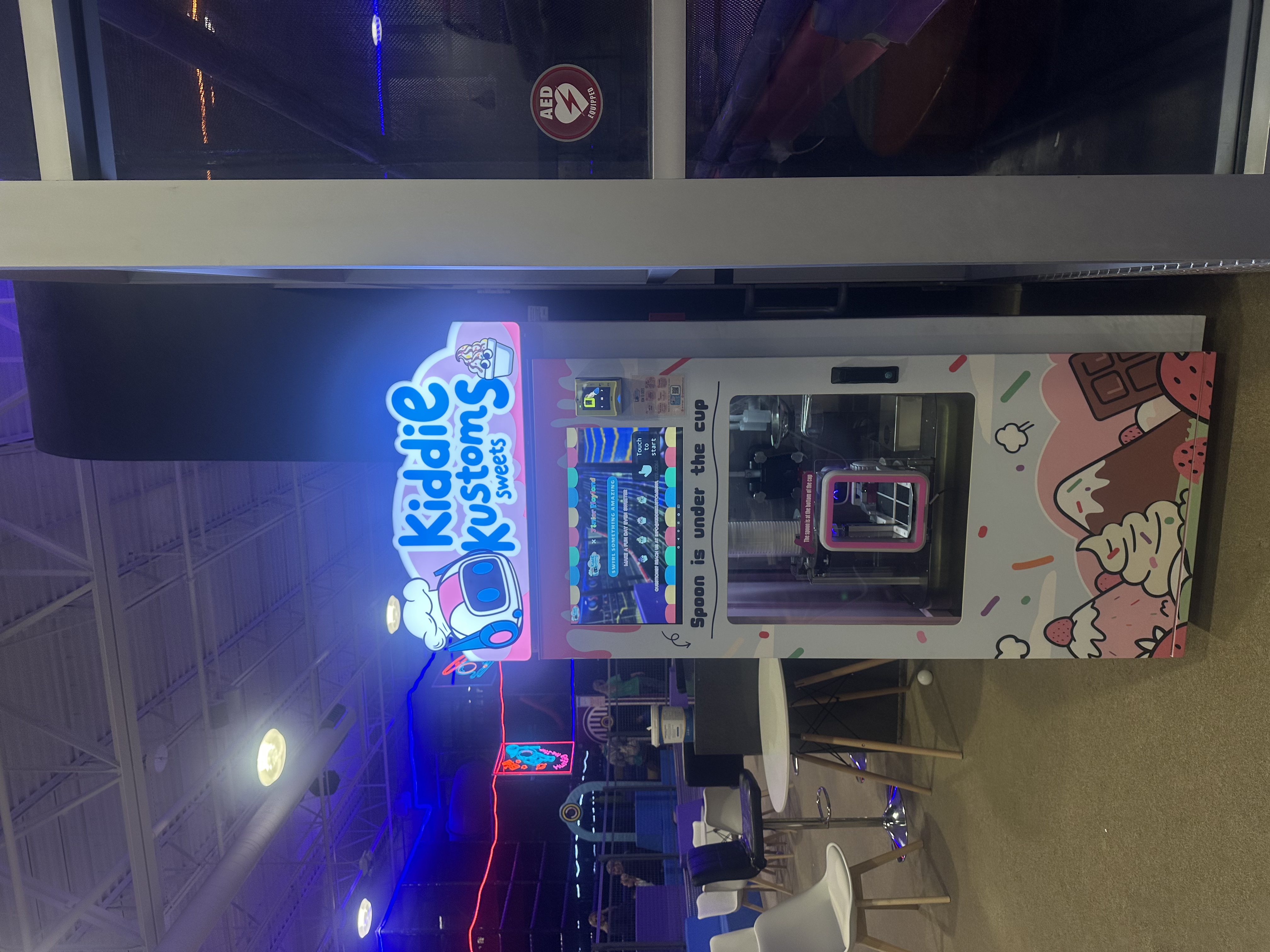
Kiddie Kustoms Sweets LLC (designs and distributes the factory-patented, CE-certified K1 robotic ice cream vending machine with a local service footprint: installation, cleaning, maintenance, restocking, and support within roughly an hour of the Philadelphia Main Line.
K1 at a glance: about 30 seconds per cup; one base flavor plus up to five toppings and syrups; a 22-inch touchscreen; cashless card payments; a 2.1-gallon tank (about 60 cups per fill); 4.6 oz servings; a footprint of about 11 sq ft (31.5"W × 50"L × 70.9"H); a 240V/20A dedicated circuit; and batch orders up to 6 cups.
Entry is flexible: buy the machine outright, or host one at no upfront cost with revenue share up to 50% and full supplier-side operations.
Live sites include Dim Sum King , The Barn Yard , Devon Lanes, Flick of the Wrist, Junior Playland , Tilted Axes, and X-Golf Garnet Valley .