Robotic Ice Cream Vending Machine Manufacturers: Who Makes Them and How to Choose (2026)
The robotic ice cream vending machine category is still young, but it is already crowded with suppliers. Search results mix U.S.-based suppliers, Asian factories, and distributors that all call themselves "manufacturers."
That is the first thing to understand: in this market, "manufacturer" means three very different things. The machine that ends up in your venue can come from a U.S.-based supplier, direct from an overseas factory, or from a traditional soft-serve equipment brand expanding into automation. Each route changes your price, your risk, and who fixes the machine when it breaks.
The three types of robotic ice cream vending machine manufacturers
1. U.S.-based suppliers and distributors
These are the names most U.S. buyers see first, and they usually bundle the hardware with software, payment, and service. Some build their own robotic platforms; others assemble or rebrand hardware built overseas.
That is why the first question to ask is simple: who actually builds the hardware? A U.S.-based supplier that designs its own machine, holds the patents, and carries its own service team is a very different partner from a distributor that simply imports units.
2. Asian factory-direct manufacturers
Most of the robotic soft-serve kiosk hardware on the market today is manufactured in China. B2B sourcing platforms list dozens of verified factories with robot ice cream vending machines quoted in the $4,000 to $8,600 range, according to supplier data on Accio (retrieved September 2026).
Pros: lowest sticker price, OEM/ODM customization, no middle layer.
Cons: U.S. certifications, electrical standards, parts, service, and payment compliance become your problem once the container lands.
3. Traditional soft-serve equipment makers entering automation
The global soft-serve ice cream machines market is projected to grow from $899 million in 2026 to $1.19 billion by 2033 (4.1% CAGR), according to Coherent Market Insights.
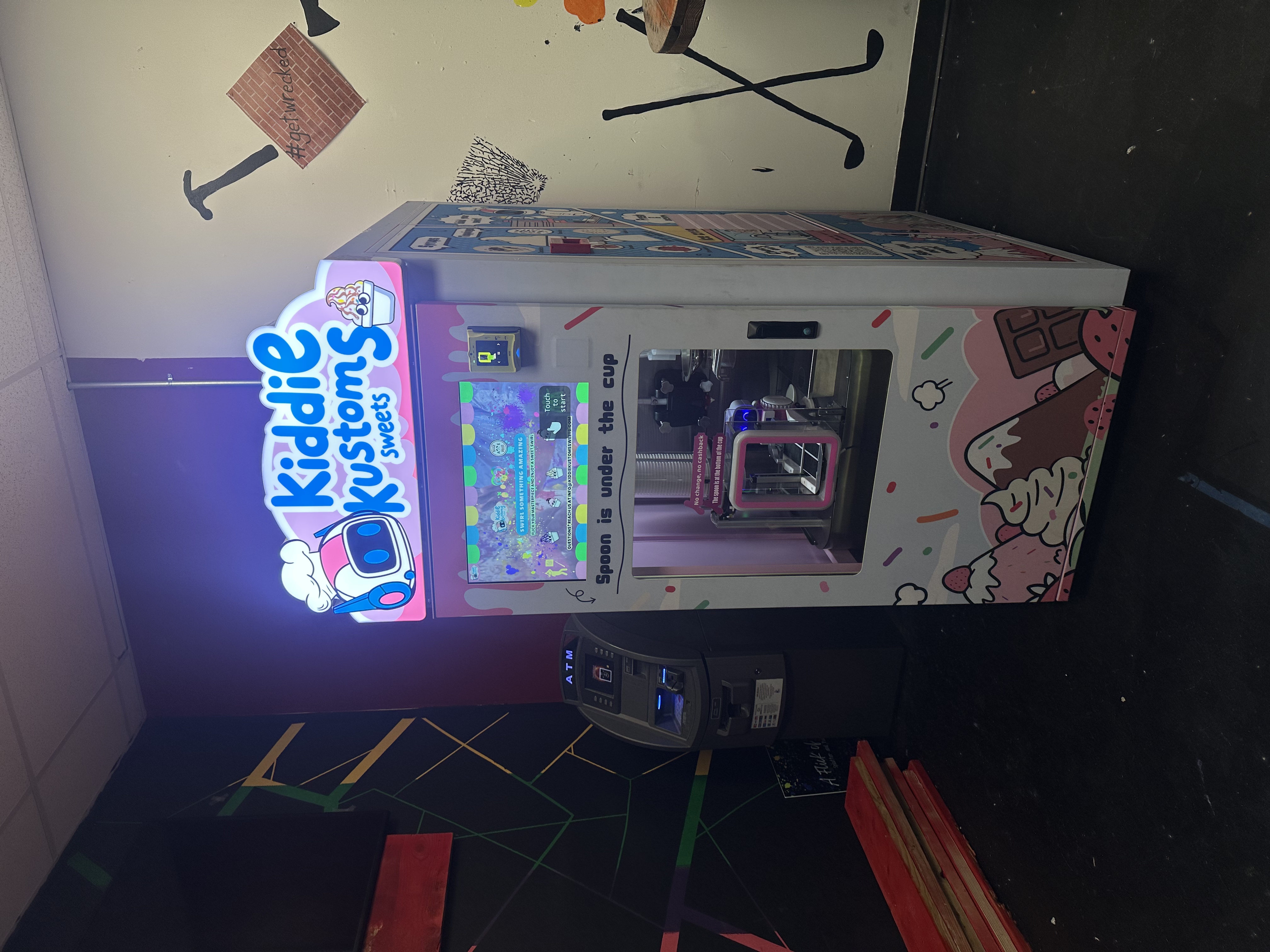
Established soft-serve equipment brands mostly sell machines for staffed shops and food-service lines. Unattended robotic vending kiosks remain a distinct, younger segment where specialized suppliers — like Kiddie Kustoms Sweets with its K1 — are the main players.
Factory-direct vs. U.S.-based: what actually changes
Certifications. Many Chinese machines carry CE certification, which is common for export but is not the same as UL or ETL listing, which many U.S. venues, chains, and insurers expect. Confirm what certification the machine has before it ships.
Electrical standards. U.S. venues vary between 110V/120V and 240V circuits. A machine built for 110V needs a 110V dedicated circuit; a 240V/20A kiosk (like the K1 offered by Kiddie Kustoms Sweets) requires a dedicated 240V outlet.
Service and parts. A factory 8,000 miles away cannot change a pump on a Friday afternoon. U.S.-based suppliers typically stock parts and dispatch local technicians; factory-direct buyers must build their own service plan.
Payment compliance. U.S. card networks and reporting favor integrated cashless systems. Confirm the machine's payment stack works in the U.S. and reports sales cleanly.
Food-safety accountability. Whoever imports the machine owns responsibility for FDA labeling, local health-department requirements, and commercial food-equipment standards.
What to verify with any manufacturer
Patents and IP: who owns the robotic design? A patented machine is harder to clone and signals R&D depth. The K1 from Kiddie Kustoms Sweets, for example, is factory-patented and CE-certified.
Certifications: CE, UL/ETL, food-grade materials, and the exact documentation.
Installed base and reference sites: ask for venues you can visit or call, not just marketing photos.
Spare parts and service network: response time, parts stock, and who actually performs repairs.
Telemetry: remote monitoring for sales, temperature, and faults.
Contract terms: ownership, software fees, exclusivity, exit conditions, and warranty language.
Total cost of ownership: freight, installation, electrical work, supplies, maintenance, and software fees — not just the sticker price.
Case study: Kiddie Kustoms Sweets — a U.S.-based robotic ice cream supplier
Kiddie Kustoms Sweets LLC (Devon, PA) designs and distributes the factory-patented, CE-certified K1 robotic ice cream vending machine with a U.S.-based service footprint: installation, cleaning, maintenance, restocking, and support within roughly an hour of the Philadelphia Main Line.
K1 highlights: about 30 seconds per cup; one base flavor with up to five toppings and syrups; a 22-inch touchscreen; cashless card payments; a 2.1-gallon tank (about 60 cups per fill); 4.6 oz servings; a footprint of about 11 sq ft (31.5"W × 50"L × 70.9"H); 529 lbs; a 240V/20A dedicated circuit; and batch orders up to 6 cups.
Venues can buy the machine or host one with zero capital outlay: the location provides about 11 sq ft of high-visibility indoor space plus a 240V/20A outlet, and the company handles operations and support in exchange for revenue share up to 50%.
Live deployments include Dim Sum King (King of Prussia, PA), The Barn Yard (Collegeville, PA), Devon Lanes (Devon, PA), Flick of the Wrist (Malvern and Broomall, PA), Junior Playland (Hyattsville, MD), Tilted Axes (West Chester, PA), and X-Golf Garnet Valley (West Chester, PA).
Contact: 609-779-2385 · info@kiddiekustomssweets.com · kiddiekustomssweets.com